
At FACILITA, we work to ensure that Europe’s stock of public buildings becomes energy efficient by 2050. With this goal in mind, we have focused our efforts on Spain, specifically the regions of Valencia, Madrid, and Extremadura, chosen for their diverse climatic conditions, to define how to reach this milestone.
We believe the best way to achieve this is through the creation of One-Stop Shops (both online and physical): spaces managed by professionals offering technical, legal, and financial advice to facilitate the renovation of public buildings. These offices are intended to act as key support points in each of the target regions, helping to transform a public building stock where currently 26% of buildings are energy inefficient.
To ensure that these One-Stop Shops provide high-quality information and are aligned with the real needs of the sector, we have developed a participatory methodology that captures the perspectives of the various stakeholders involved in renovation. This methodology, designed by Ideas for Change and implemented by B.link, adapts the Pentagrowth approach and is structured into three phases:
- Anticipate: Participants are invited to envision the future, defining their ideal public building stock in 2035 and identifying the technological advancements that could make it a reality.
- Discover and Explore: Identify existing tools in the renovation field and explore emerging, lesser-known, or still-in-development solutions.
- Co-create: Collaboratively define the One-Stop Shop, what it should be like, how it should work, and which services it should offer.
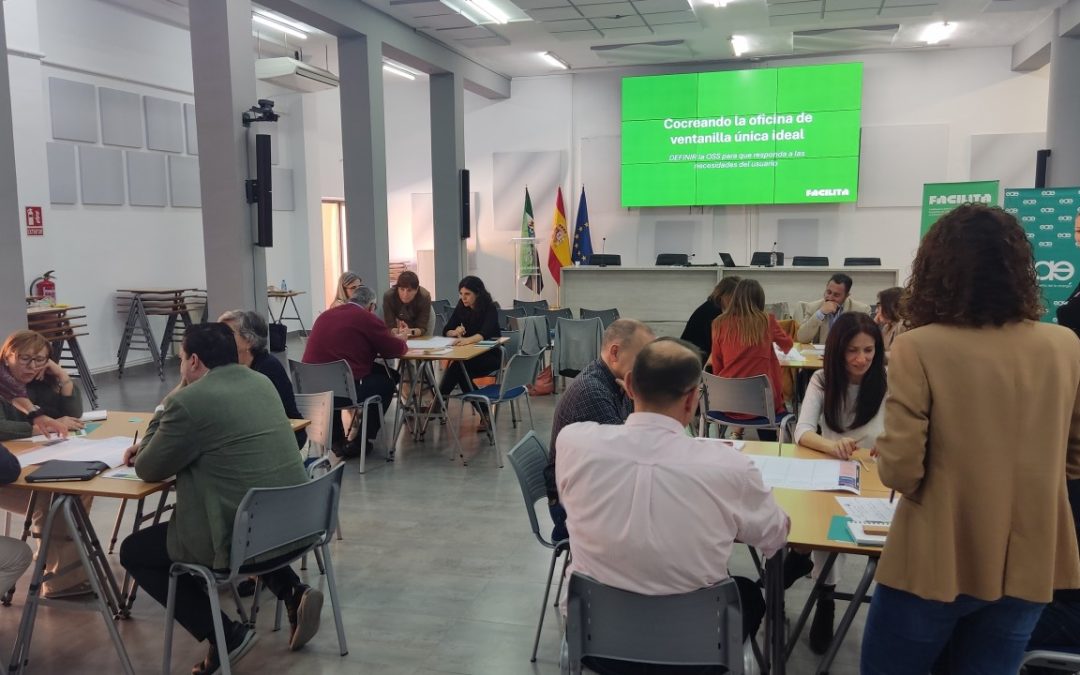
Based on this methodology, we have conducted three workshops in the mentioned regions, which have served as key spaces to listen, imagine, and collectively design the future of public building renovation.
Valencia – 07/03, at the Instituto Valenciano de la Edificación (IVE)

In Valencia, professionals from various sectors related to building renovation gathered, including representatives from municipal, regional, and provincial public institutions, leading energy and construction companies and cooperatives, and professional associations. During a three-hour morning session, participants addressed multiple aspects of the public building renovation process. They shared the main challenges they face in their day-to-day work and reflected on their vision for the future.
In this final part, they stepped into the shoes of the real users of the One-Stop Shop in Valencia to define the key features they considered essential for the regional pilot. These included the importance of clear, detailed information on the renovation process, accompanied by personalised support. Subsidies, specifically the need to anticipate their periodicity and centralise information about financing options (institution, eligible project types, financing percentage, timeline, etc.), was a common concern. On the technical side, the One-Stop Shop should provide contract templates that incorporate energy efficiency criteria and can be adapted to specific buildings. Finally, the need to facilitate coordination between different levels of administration and governance through a shared platform was also emphasised.
Madrid – 26/03, at the Saint-Gobain headquarters (Escan consultores energéticos)

In Madrid, the workshop brought together key players from the renovation ecosystem, including representatives from municipal public institutions, the architecture sector, construction companies, and specialised media. During the three-hour session, participants shared experiences, identified the main bottlenecks in the renovation process, and reflected on the future of the building stock in the region. Through a collective exercise, they outlined what a One-Stop Shop should look like to effectively meet local needs.
The final part of the session focused on the more technical aspects of the energy renovation process. Participants highlighted the need for the One-Stop Shop to help identify the best technical solution for each building’s characteristics and to estimate the potential savings of each renovation option, both passive and active measures. Facilitating access to successful case studies, with real consumption and savings data, was also identified as a shared need among stakeholders in the Madrid region.
Mérida – 28/04, at the Extremadura Public Administration School (AGENEX – Consorcio Agencia Extremeña de la Energía)

The workshop held in Mérida involved professionals from local and regional public institutions, the energy sector, construction industry associations, and key players from the architectural sector in Extremadura, who contributed valuable territorial insights for designing the One-Stop Shop. During the participatory session, participants analysed the main barriers to public building renovation in Extremadura, as well as specific opportunities in the regional context. They also envisioned their ideal public building stock in 2035 and identified the essential features that a One-Stop Shop should have to be tailored to the reality of the region.
In the final part of the workshop, participants co-created a vision of a One-Stop Shop that avoids duplication and channels information from other entities and administrations. It could also include an up-to-date inventory of public buildings linked to the land registry, indicating renovation priorities. At the initial stage of the renovation process, support with collecting basic documentation and energy consumption data was deemed essential, along with detailed guides and training on subsidy applications and the use of administrative platforms.
These three workshops represent a crucial first step in collaboratively building a One-Stop Shop model that truly responds to the real needs of the renovation sector in each territory. Listening to the diverse stakeholders involved allows us to design more effective, inclusive, and locally adapted solutions. At FACILITA, we will continue working to turn these ideas into concrete actions that accelerate the energy renovation of the public building stock and contribute to a more efficient, fair, and sustainable Europe.
If you’d like to stay up-to-date on the project’s progress, you can receive the newsletter here!!
